

JFK to Manhattan
Seven ways to get from the airport into the city — ranked by price, with advice to help you decide which one is right for you.
Going the other way? See Manhattan to JFK →
After a long flight, getting from JFK to Manhattan shouldn’t be another problem to solve. We’ve laid out every realistic option — with information covering cost, time, and when each one makes sense.
Below are seven options listed in ascending price order.
Approximate one-way costs to Midtown Manhattan. Rideshare prices vary by time of day and surge pricing. Verify current fares before you travel.
| Method | Cost | Time | Best For |
|---|---|---|---|
| Public Transit | |||
| AirTrain + SubwaySee note 1 | $11.75Two separate fares | ~70 min | Cheapest |
| AirTrain + LIRRvia Jamaica StationSee note 2 | $14.00 / $16.00Off-peak / PeakSenior/Disabled: $12.25 | ~35–45 min | ⭐ Best Balance |
| Road | |||
| Shared VanGo Airlink NYC · Uber ShuttleSee note 3 | ~$27–$40Varies by pickup type | ~60 min | Budget, No Planning |
| Yellow TaxiSee note 4 | $70 flat rateAll-in typically $85–$120 + tip | ~45–60 min | Easiest After Landing |
| Uber / LyftSee note 5 | $80–$150+Varies widely · Check app | ~47–60 min | Flexible, Door-to-Door |
| Car Service / LimoSee note 6 | From ~$180+ tip, tolls & fees | ~45–60 min | Comfort, Zero Hassle |
| Premium | |||
| HelicopterBLADE | $195/seatCharter from $1,875 | ~5 min | High-End & Fastest |
Subway from JFK to Manhattan
The subway is the cheapest option from JFK to Manhattan — but also the slowest and least comfortable for most travelers, especially with luggage.
Taking the subway from JFK is a two-step process: take the AirTrain to a subway station in Queens, then ride the subway into Manhattan.
Download · Print Subway: JFK Airport to Manhattan — Flow Chart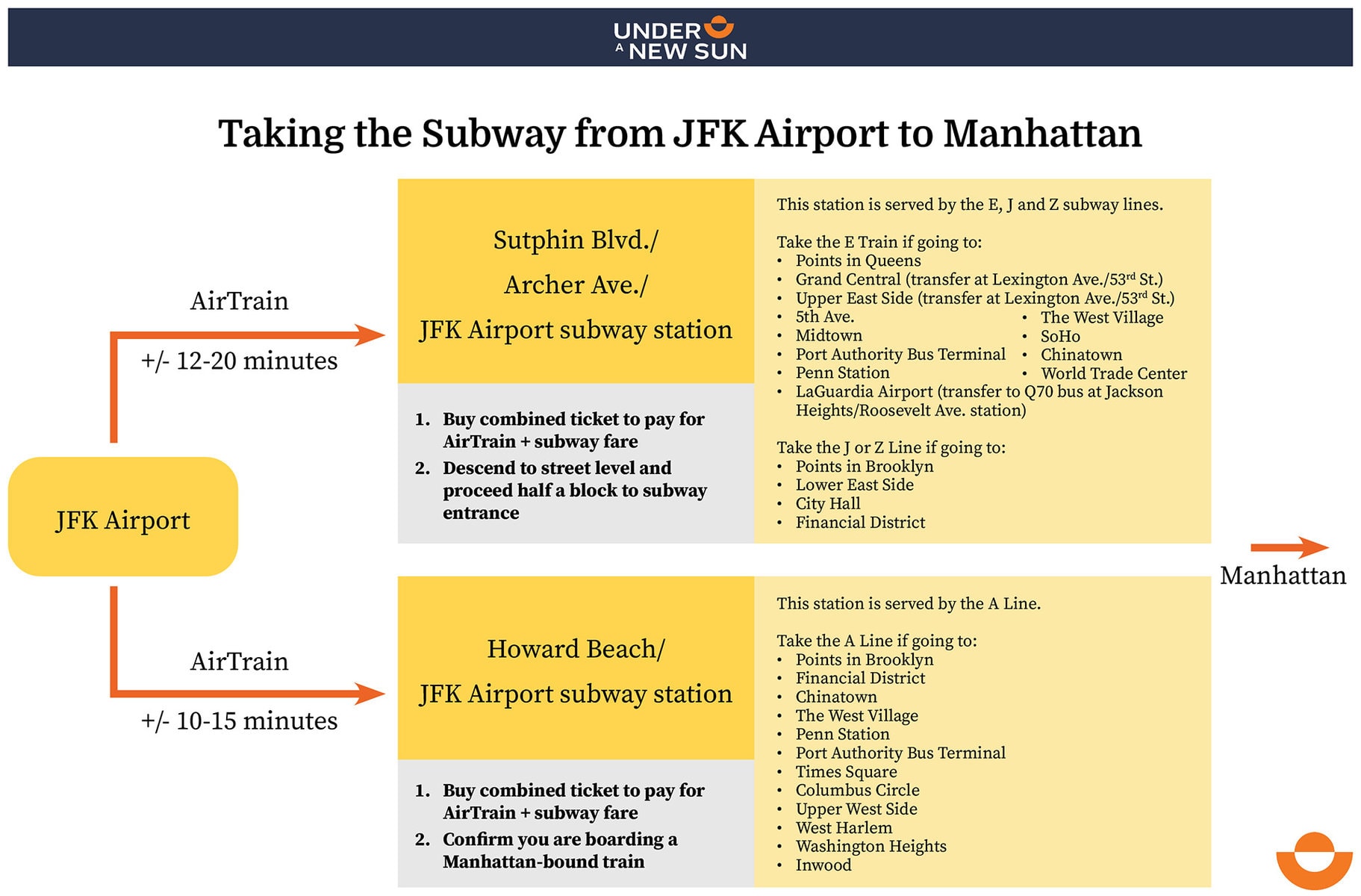
When the subway makes sense
Good choice if you are:
- Traveling on a tight budget
- Familiar with NYC transit
- Not carrying much luggage
- OK with a longer trip
Consider other options if you:
- Are arriving late at night
- Have significant luggage
- Want a faster, more predictable trip
- Are unfamiliar with the subway system
Step 1 — Take the AirTrain from JFK
At JFK, follow signs for the AirTrain. The AirTrain has two branches — make sure you board the correct one for your destination:
- Howard Beach/JFK Airport subway station — take the A train into Manhattan
- Sutphin Blvd./Archer Ave./JFK Airport subway station — take the E, J, or Z train into Manhattan
The JFK AirTrain
- Operates 24/7/365
- Stops at all JFK terminals
- Free to ride within the airport
- Fare charged when used to access the subway or LIRR
- AirTrain fare is paid at the subway/LIRR station, not at the airport
- Trains arrive every few minutes
- Children under 5 ride free
Step 2 — Take the subway to Manhattan
Once you reach the subway platform, board the train that serves your Manhattan destination. Most trips take 45–70 minutes depending on the line and stops.
Howard Beach/JFK Airport station — A train
Choose the A train if you’re heading to:
- Points in Brooklyn
- Financial District / City Hall
- Chinatown / The West Village
- Penn Station / Port Authority Bus Terminal
- Times Square / Columbus Circle
- Upper West Side / West Harlem / Washington Heights / Inwood
Sutphin Blvd./Archer Ave. station — E, J, Z trains
Choose the E train if you’re heading to:
- Midtown / 5th Ave.
- Grand Central Terminal (transfer at Lexington Ave./53rd St.)
- Upper East Side (transfer at Lexington Ave./53rd St.)
- Penn Station / Port Authority Bus Terminal
- The West Village / SoHo / Chinatown / World Trade Center
- Points in Queens
- LaGuardia Airport (transfer to Q70 bus at Jackson Heights/Roosevelt Ave.)
Choose the J or Z train if you’re heading to:
- Points in Brooklyn
- Lower East Side / Financial District
Note: The Sutphin Blvd./Archer Ave. subway station and the Jamaica LIRR station are in the same complex, but different areas. Follow signs to the street level and walk half a block to reach the subway entrance.

Paying the AirTrain + Subway fare
Once inside the train station, look for a ticket machine and select the combined ticket option. A combined ticket covers both the AirTrain fare ($8.75) and the subway fare ($3.00).

Long Island Rail Road from JFK to Manhattan
If you want the best balance of speed, cost, and ease — this is it. The Long Island Rail Road (LIRR) gets you into Manhattan faster than the subway, avoids all traffic, and costs only a few dollars more.
Why we recommend the LIRR
Advantages
- Faster than the subway — fewer stops, direct service into Manhattan
- Avoids traffic entirely — no tunnel or highway delays
- More comfortable — easier with luggage, less crowded
- Still affordable — typically under $20 total
Great choice if you are:
- Arriving during the day or early evening
- Heading to Midtown, Penn Station, or Grand Central
- Traveling with light-to-moderate luggage
- Wanting to get into Manhattan quickly without hailing a cab
Consider alternatives if you:
- Are arriving very late at night (limited service)
- Have a lot of luggage
- Need completely door-to-door service
- Are trying to spend as little as possible
Step 1 — Take the AirTrain to Jamaica Station
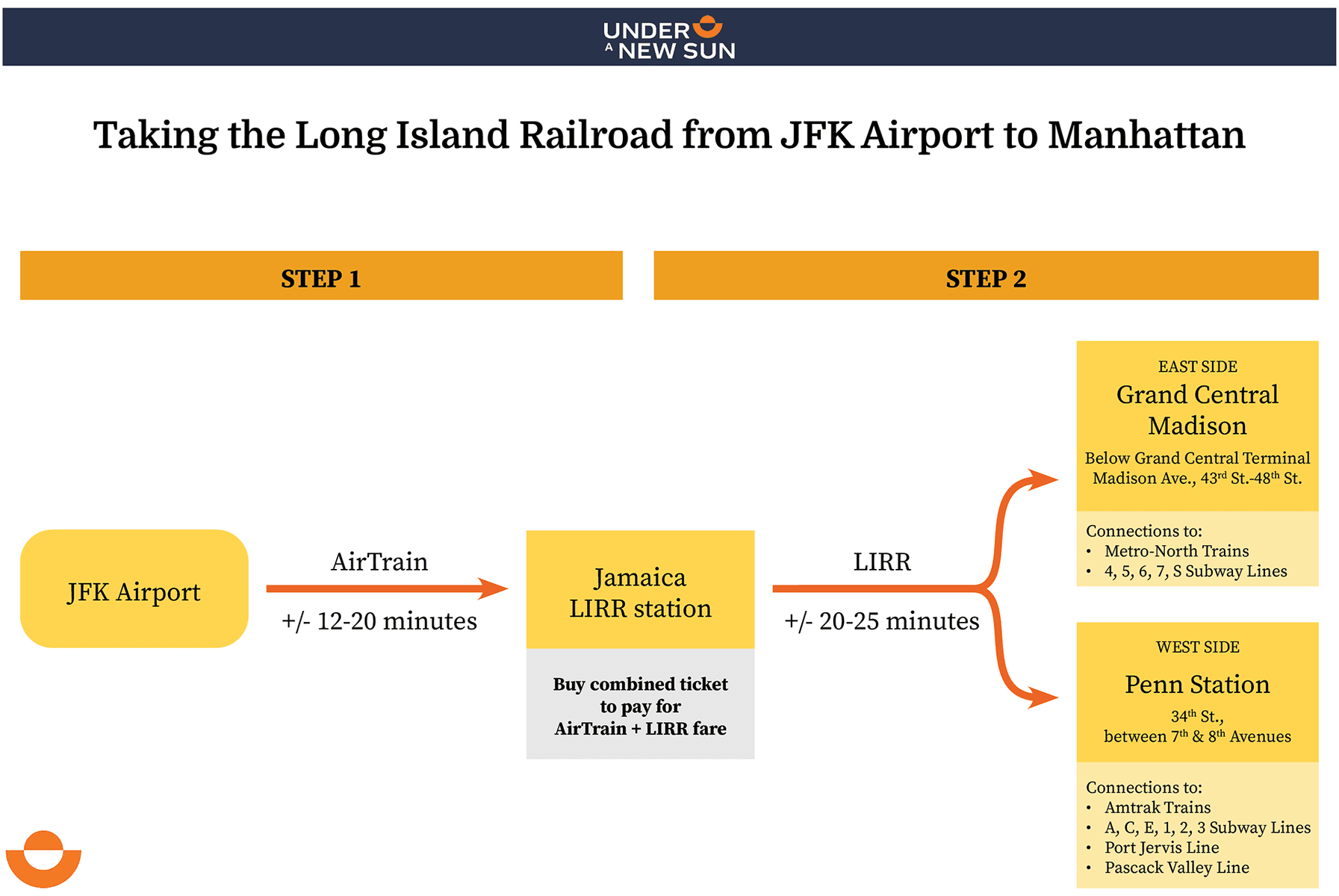
At JFK, follow signs for the AirTrain and board the branch headed to Jamaica (not Howard Beach). The AirTrain ride to Jamaica Station takes approximately 12–20 minutes.
The JFK AirTrain
- Operates 24/7/365
- Stops at all airport terminals
- Free to ride within the airport
- Charges a fare when used to access the LIRR or subway
- AirTrain fare is paid at Jamaica Station, not at the airport
- Arrives every few minutes
- Important: Make sure your AirTrain is bound for Jamaica
Step 2 — Take the LIRR from Jamaica to Manhattan
Before arriving at Jamaica Station, decide whether you want to arrive on Manhattan’s East Side or West Side — the LIRR serves both.
East Side — Grand Central Madison
- Subterranean station beneath Grand Central Terminal
- Located on the East Side, running along Madison Ave. between 43rd & 48th St.
- Subway connections: 4, 5, 6, 7, S lines (inside Grand Central Terminal, one level up)
- Metro-North connections: Hudson, Harlem & New Haven Lines
West Side — Penn Station
- Located at 34th St. between 7th & 8th Avenues
- Subway connections: A, C, E, 1, 2, 3 lines
- Amtrak and NJ Transit connections
Paying your LIRR fare
Buying your ticket
At Jamaica Station, look for the ticket machines marked Long Island Railroad (located at the far right of the machine area). Purchase a combined ticket — this covers both your AirTrain fare and your LIRR fare in one transaction.
When buying your ticket, choose:
- From: Jamaica
- To: Grand Central or Penn Station
Your fare will be priced automatically as a CityTicket — the LIRR fare class for trips that start and end within New York City.
Off-peak trains cost less than peak-hour trains:
- Morning peak: 6 a.m.–10 a.m., Monday–Friday (excluding holidays)
- Evening peak: 4 p.m.–8 p.m., Monday–Friday (excluding holidays)
- Off-peak: All other times
Two ways to pay your LIRR fare:
- Buy at a ticket machine at Jamaica Station (combined AirTrain + LIRR ticket)
- Use the MTA Train Time app (App Store / Google Play) for the LIRR portion
Transferring from Metro-North
If you’re continuing beyond Manhattan on Metro-North (Hudson, Harlem, or New Haven Lines), arrive at Grand Central Madison and follow signs up to Grand Central Terminal. The Metro-North platforms are in the upper levels of the original station.
Shared Van from JFK to Manhattan
Three shared ride options serve the JFK–Manhattan route — all with fixed pricing and no surge. That fixed pricing is the key advantage: you know the cost before you leave the airport, and it won’t change based on traffic or demand. The trade-off is time — shared vehicles make multiple stops, and road traffic from JFK can be slow. Budget 60–90 minutes and you’ll rarely be caught short.
Choosing between the three options
Grand Central Express — best if you’re heading to Midtown East
Lowest price, fixed drop-off at 41st & Park. You’re delivered to one point — not your hotel door. Ideal if Grand Central is your destination or you’re comfortable making your own way from there.
Door-to-Door Shared Ride — best if you want delivery to your address
Costs a bit more, but the driver takes you directly to your hotel or residence. Worth it after a long flight if you have heavy luggage and don’t want to navigate from a fixed drop-off point. Expect more stops and a longer overall journey.
Uber Shuttle — best if you prefer booking through an app you already use
Same fixed-price concept, booked directly in the Uber app. Good for travelers already comfortable with Uber who want a no-surprise fare without signing up for a new service.
A — Grand Central Express (Go Airlink NYC)
Go Airlink NYC’s Grand Central Express picks you up at your terminal and brings you directly to their fixed stop at East 41st Street and Park Avenue — one block from Grand Central Terminal. Starting at ~$27 per person, it’s the most affordable shared ride option from JFK. The drop-off is fixed — you end up at 41st & Park, not at your hotel door.
- Proceed to the Welcome Center in your terminal, use the courtesy phone, and dial #18 to confirm your reservation
- Departures hourly, 8 a.m.–9 p.m., 7 days a week
- Book in advance — walk-up not guaranteed
- Cancel up to 4 hours before pickup for a full refund
- May operate under the name NY Airport Service — same company, don’t be surprised
- Travel time: ~60–90 min from JFK to Grand Central
B — Door-to-Door Shared Ride (Go Airlink NYC)
Go Airlink NYC picks you up curbside at your JFK terminal and drops you at your Manhattan hotel, residence, or transit hub. Expect to pay ~$35–40. Shuttles make multiple stops, so build in extra time — this option trades speed for the convenience of not having to navigate from a fixed drop-off point after a long flight.
- Curbside pickup at your arriving terminal
- Service from 4 a.m.–midnight
- Choice of shared van, private sedan, SUV, or chartered coach for groups
- Also serves cruise terminals and outer boroughs
- Licensed by the Port Authority of NY & NJ
C — Uber Shuttle
Uber Shuttle runs on fixed routes with scheduled departures — book through the Uber app by selecting “Shuttle” instead of a standard ride. Pricing is fixed per seat and doesn’t surge, making it predictable for budget-conscious travelers who want a set-and-forget option from the airport.
- Fixed routes between JFK and Port Authority, Grand Central, Chinatown, or Atlantic Terminal (Brooklyn)
- Scheduled departures every 30 minutes, 5 a.m.–10:45 p.m. daily
- Typical fare ~$25 per seat, up to 4 seats per booking
- One piece of luggage plus one personal item included
Taxi from JFK to Manhattan
The yellow cab fare from JFK to Manhattan is one of the few genuinely fixed prices in New York City transportation. The Taxi and Limousine Commission sets a flat rate of $70 for any trip from JFK to any destination in Manhattan below 96th Street — it doesn’t matter how bad traffic is on the Van Wyck Expressway. You pay $70 either way. For trips delivered above 96th Street, additional costs apply.
That flat rate is the base. What gets added on top depends on when you travel and where you’re going.
What gets added to the flat rate
| Fee or surcharge | Amount | Notes |
|---|---|---|
| Flat rate | $70.00 | JFK to anywhere in Manhattan below 96th St. · does not vary with traffic |
| MTA surcharge | $0.50 | Applied to all trips |
| Improvement surcharge | $1.00 | Applied to all trips |
| NY State congestion surcharge | $2.50 | Applied to all trips |
| Airport Access Fee | $2.00 | Applied to all airport trips |
| Congestion pricing toll | $0.75 | Destinations south of 60th St. only |
| Overnight surcharge | $1.00 | 8 p.m.–6 a.m. only |
| Rush hour surcharge | $5.00 | 4–8 p.m. weekdays, excluding holidays |
| Tip | 15–20% | Customary and expected · not included in any estimate |
| Typical all-in total | ~$88–$110 | Before tip · varies by time of day |
When the taxi makes sense
The flat rate works strongly in your favor during rush hour. When an Uber from JFK is surging to $120–$150, the yellow cab is still $70 flat — plus the same modest surcharges it always charges. You don’t need an app, you don’t wait for a driver to accept, and you can get in immediately at the taxi stand outside arrivals. For groups of 1–4 passengers, the flat rate covers everyone in the cab — better value per person as the group grows.
Where taxis lose ground: off-peak hours when Uber isn’t surging. An UberX at 11 a.m. on a Tuesday might run $60–$75 all-in, cheaper than the yellow cab total. Check the app when you land before committing either way.
Uber / Lyft from JFK to Manhattan
Rideshare is the most flexible option after landing — the apps automatically identify which JFK terminal you’re arriving in and direct you to the designated pickup area. No hunting for a taxi stand, no guessing. The variables are surge pricing and the Van Wyck Expressway, both of which can work against you during peak periods.
What will it cost?
From JFK to Midtown Manhattan, expect a base fare of $80–$110 under normal conditions for a standard UberX or Lyft. During surge pricing — weekday rush hours, Friday evenings, Sunday nights, bad weather — that range climbs to $130–$180+. Always check the app when you land for a live estimate. If the price looks high, waiting 10–15 minutes in arrivals often catches a surge as it drops.
When the yellow cab beats the app
The yellow taxi flat rate never surges. When Uber and Lyft are pricing at $120–$150 from JFK, a yellow cab is still $70 flat plus the same modest surcharges it always charges. During weekday rush hours (4–8 p.m.), bad weather, and holiday travel periods, it takes 30 seconds to compare the app estimate against the known taxi total. If the Uber is under $90, it may be competitive. Over $110, the taxi is almost certainly cheaper — and the cab stand is right outside arrivals.
Where is the rideshare pickup?
At JFK, rideshare pickup zones are terminal-specific — follow the signs in your terminal for “Rideshare” or “App-Based Vehicles.” Each terminal has a designated area, which may be on a different level or in a separate lot from the taxi stand. The app will show you exactly where to go once your ride is confirmed. Don’t wait at the general curbside — drivers can’t stop there for app pickups.
Scheduling vs. on demand
If you know your flight’s arrival time in advance, scheduling an Uber or Lyft before you fly locks in a fare estimate and has a driver dispatched to meet you. This is especially useful for early morning arrivals or during periods when demand is predictably high. On-demand after landing works fine in most cases — just allow a few minutes for a driver to accept and arrive at your terminal.
With heavy luggage
After a long international flight with multiple bags, select Uber XL or Lyft XL to ensure a larger vehicle. Standard vehicles have limited trunk space and drivers can decline trips when luggage won’t fit. XL costs roughly 30–50% more but eliminates the risk of a cancellation when you’re already at the curb with your bags.
Factors affecting your price
- Type of vehicle requested
- Time of day and current demand (surge pricing)
- Number of passengers
- Trip distance and duration
- Tolls
- Delays (traffic, weather, accidents, etc.)
- Tip not included in price estimate — 15%–20% is recommended
Car Service / Limo from JFK to Manhattan
The door-to-airport service these companies provide is invaluable when you want to reduce the stress of travel. Licensed car service vehicles — whether a sedan, SUV, or stretch — are a step above both taxis and rideshare in space and comfort: more legroom, more trunk capacity for luggage, and a driver who is expecting you specifically.
After a long international flight, that predictability matters. You clear customs, walk out, and your driver is already there — no app check, no waiting for a match, no surge calculation. For travelers with significant luggage, families, or anyone who simply doesn’t want to think on arrival, car service earns its premium.
With so many private vehicle companies in New York, how do you choose? We’ve vetted the company below for consistent quality — 4.8/5 stars on Google Reviews with 500+ reviews.
Final cost depends on destination, vehicle type, number of passengers, and your tip.
Helicopter from JFK to Manhattan
Ever wonder what being a New York power player feels like? Here’s your chance.
Blade is a private aviation company whose helicopters come very close to being time machines. The average helicopter flight from JFK to Manhattan lasts about five minutes — and there’s no better way to announce your arrival in New York City.
Blade’s JFK to Manhattan helicopter service
- Reserve individual seats or charter a helicopter
- Optional meet-and-greet at JFK baggage claim — ground transfer to the helipad included
- Manhattan heliport: West 30th St., Hudson Yards (Midtown West)
- Fly frequently? The Blade Airport Pass ($695/year) cuts $100 off every seat
- Extra luggage? Use Blade’s ToteTaxi service, or ship ahead of time
- Review Blade’s luggage policies before you book
Maps & Resources
JFK AirTrain
JFK AirTrain Map & GuideFrequently Asked Questions
John F. Kennedy International Airport (JFK) is located in Jamaica, Queens, New York City — approximately 16 miles (26 km) by road from Midtown Manhattan. It sits near Jamaica Bay on the southern edge of Queens. Despite the relatively short distance, road travel time to Manhattan typically runs 35–75 minutes depending on traffic.
Yes. JFK is the largest and busiest of New York City’s three major airports, handling over 62 million passengers in 2025. It is also the United States’ busiest international gateway, with nonstop service to more destinations worldwide than any other U.S. airport. The other two NYC-area airports — LaGuardia (LGA) and Newark (EWR) — are closer to Manhattan but handle far less international traffic.
Yes. JFK operates around the clock, and the AirTrain runs 24/7. However, the LIRR does not run 24 hours — train frequency drops sharply after midnight and some connections require longer waits. Taxis and rideshare are always available. If you’re arriving on a late-night or early-morning flight, factor in reduced LIRR schedules and consider a taxi or rideshare instead.
Terminal 4 — the main international hub, handling the bulk of international arrivals and departures.
Terminal 5 — a dedicated domestic and near-international terminal on the north side of the airport.
Terminal 7 — currently operated by JFK Millennium Partners during the transition period to the new Terminal 6.
Terminal 8 — a major hub for transatlantic and domestic service on the south side.
JFK is in the middle of a historic $19 billion redevelopment. New Terminal 1 — a 2.6 million square-foot replacement for the old T1, T2, and T3 — is opening in phases from mid-2026. New Terminal 6 is also opening in 2026 and will connect to Terminal 5. With roughly 50 airlines changing terminal assignments in 2026, always confirm your terminal on your ticket or your airline’s website before heading to the airport.
The AirTrain is JFK’s own automated rail system — think of it as the airport’s internal shuttle. It loops between all the terminals and connects to two off-airport transit hubs:
Jamaica Station — where you connect to the LIRR (Long Island Rail Road) or the E, J, and Z subway lines into Manhattan.
Howard Beach — where you connect to the A subway line into Manhattan.
Within the airport — between terminals — the AirTrain is free. You only pay the $8.75 fare when you exit at Jamaica or Howard Beach to continue your journey into the city.
Between terminals, yes — it’s free. If you’re connecting between JFK terminals, you can ride the AirTrain at no cost.
If you’re leaving the airport and exiting at Jamaica or Howard Beach, the one-way fare is $8.75, paid via OMNY (tap your credit/debit card, phone, or smartwatch) or at a ticket machine.
You pay when you exit the AirTrain at Jamaica or Howard Beach — not when you board at the terminal. Two options:
OMNY (contactless tap): Tap your credit card, debit card, smartphone, or smartwatch at the OMNY reader at the fare gate.
Ticket machine: At Jamaica or Howard Beach stations, ticket machines sell combined AirTrain + LIRR tickets or AirTrain-only tickets.
Yes, for now. MetroCard sales ended across the MTA system on December 31, 2025, but existing MetroCards remain valid to use at AirTrain fare gates through a grace period extending into 2026. OMNY (tap your contactless credit/debit card or phone) is the recommended payment method.
Jamaica is almost always the better choice. It connects to both the LIRR (fastest option into Manhattan) and the E, J, and Z subway lines. From Jamaica you can reach Penn Station in about 20 minutes by LIRR, or Grand Central Madison in a similar time.
Howard Beach connects only to the A subway line, which is slower and makes many stops before reaching Manhattan. Howard Beach is a reasonable option if the A train serves your exact destination well — for example, if you’re heading to the Far West Side, Harlem, or Washington Heights.
The AirTrain ride from a terminal to Jamaica Station takes approximately 12–20 minutes, depending on which terminal you depart from and how many stops the train makes along the loop. Howard Beach is a similar travel time. The AirTrain runs 24/7 and trains come frequently — typically every few minutes during normal hours.
JFK is not directly connected to the subway — you need to take the AirTrain first. The process is two steps:
Step 1: At your terminal, follow signs for the AirTrain. Board toward Jamaica or Howard Beach depending on which subway line you want. Pay the $8.75 AirTrain fare when you exit.
Step 2: Transfer to the subway. From Jamaica, take the E, J, or Z train. From Howard Beach, take the A train. Pay the $3.00 subway fare separately with OMNY.
Total cost: $11.75 per person. Total time: approximately 60–80 minutes to Midtown.
E train (from Jamaica via Sutphin Blvd station): Runs to Midtown via Queens Plaza, then 5th Ave, 53rd St, Lexington Ave, and down to the World Trade Center. Good for Midtown East, Penn Station area, and Lower Manhattan.
J / Z trains (from Jamaica via Sutphin Blvd station): Slower, local service to lower Manhattan and Brooklyn.
A train (from Howard Beach): Makes express stops through Brooklyn before reaching Manhattan, then continues up the West Side. Best for West Side and Upper Manhattan destinations.
Take the AirTrain toward Howard Beach. Exit at Howard Beach/JFK Airport station, pay the $8.75 AirTrain fare, and follow signs to the Howard Beach–JFK Airport subway station on the street level. Board any southbound A train.
Take the AirTrain toward Jamaica. Exit at Jamaica Station, pay the $8.75 AirTrain fare, and follow signs for the subway (not the LIRR). Walk outside and down to the Sutphin Blvd–Archer Ave–JFK Airport subway station.
Note: The Sutphin Blvd subway station entrance is half a block outside of Jamaica Station — follow the street-level signs carefully.
Yes — the Long Island Rail Road (LIRR). Take the AirTrain to Jamaica Station, then board an LIRR train to Manhattan. It’s the fastest public transit option: about 35–45 minutes total from terminal to Penn Station or Grand Central Madison, with no traffic delays.
Total cost: approximately $14.00–$16.00 per person ($8.75 AirTrain + $5.25–$7.25 LIRR CityTicket).
Take the AirTrain to Jamaica Station. At the ticket machines, purchase a combined AirTrain + LIRR ticket. Board any LIRR train bound for Penn Station. The LIRR ride from Jamaica to Penn Station takes approximately 20–25 minutes.
Important: Do not buy your ticket on board — an $8.00 on-board surcharge applies.
Take the AirTrain to Jamaica Station, buy a combined ticket, and board an LIRR train to Grand Central Madison — the LIRR’s East Side terminal beneath Grand Central Terminal. The LIRR ride from Jamaica takes approximately 20–25 minutes.
A CityTicket is a discounted LIRR fare for trips that both start and end within New York City limits. Since Jamaica Station (Queens) and Penn Station / Grand Central Madison (Manhattan) are both within the city, the JFK-to-Manhattan LIRR trip qualifies.
CityTicket prices as of January 2026: $5.25 off-peak and $7.25 peak. Add the $8.75 AirTrain fare for your total.
No — they are completely separate systems. The LIRR is a commuter rail line with its own stations, platforms, ticketing, and trains. You cannot use OMNY or a subway fare on the LIRR. You need a separate LIRR ticket, purchased at a station ticket machine or via the MTA Train Time app.
Yes — the MTA Train Time app (available on iOS and Google Play) lets you purchase LIRR tickets on your phone. However: the AirTrain fare cannot be purchased through the app. You must pay the $8.75 AirTrain fare separately at a ticket machine at Jamaica or Howard Beach station.
The cheapest option is the AirTrain + subway, at approximately $11.75 per person. The trade-off is time — expect 60–80 minutes and a fair amount of walking and stairs with luggage.
The next cheapest is the AirTrain + LIRR, at roughly $14.00–$16.00 per person. It’s much faster (35–45 minutes), far more comfortable, and barely more expensive — which is why we consider it the better deal for most travelers.
AirTrain + LIRR: 35–45 minutes. The most consistent option — no traffic delays.
AirTrain + Subway: 60–80 minutes. Slower, more stops, more transfers.
Taxi / Rideshare: 35–75 minutes with no traffic; 60–120+ minutes during rush hour. The Van Wyck Expressway (the main road from JFK) is one of the most congested roads in New York.
JFK is approximately 16 miles (26 km) by road from Midtown Manhattan. Despite the relatively modest distance, the notorious Van Wyck Expressway can make the road trip feel much longer during peak hours. The LIRR bypasses road traffic entirely.
New York City taxis charge a flat rate of $70 from JFK to any destination in Manhattan (below 96th Street). This flat rate is set by the NYC Taxi and Limousine Commission and applies to all yellow cabs — the driver cannot legally charge more or less for the base fare.
The flat rate does not include tolls, tip, or surcharges.
Base flat rate: $70.00
Tunnel or bridge toll (if applicable): $6–$9
MTA state surcharge: $1.00
Congestion pricing surcharge (entering below 60th St): $0.75
Tip (15–20%): $10–$15
Realistic total: $88–$105 depending on route and tip.
Additional surcharges that may apply: overnight ($1.00), rush hour ($5.00 weekdays 4–8 PM), NY State surcharge ($1.00), Airport Access Fee ($2.00).
Rideshare pickup locations vary by terminal and have shifted in 2025–2026 due to JFK’s ongoing construction. Always follow the pickup instructions in your Uber or Lyft app — the pin location shown in the app is your guide. Never accept a ride from someone who approaches you in the terminal — legitimate for-hire rides must be arranged through the app.
Sometimes, but not always. A standard UberX to Manhattan might run $50–$80 during off-peak hours, making it cheaper than the taxi all-in. But during surge pricing (Friday evenings, Sunday nights, rain, holidays), Uber can easily hit $120–$150 or more — significantly more than the taxi flat rate.
The yellow taxi flat rate is fixed by law and never surges. If you’re traveling during peak hours or bad weather, the taxi is often the smarter financial choice.
Yes — JFK is in the middle of the largest airport construction project in U.S. history. The Port Authority of New York and New Jersey is overseeing a $19 billion transformation expected to be largely complete by 2030.
New Terminal 1 — a massive 2.6 million square-foot international terminal replacing the old T1, T2, and T3. Opening in phases from mid-2026.
New Terminal 6 — a 10-gate boutique international terminal connecting to Terminal 5. Opening in phases from 2026.
With roughly 50 airlines changing terminal assignments in 2026, always confirm your terminal on your ticket or airline website.
JFK opened in 1948, but wasn’t connected to any rail transit until the AirTrain opened in 2003: a 55-year gap. Proposals for a direct rail link came and went for decades, repeatedly killed by cost concerns, political disagreements, and competing interests between city and state agencies.
Even today, the connection isn’t truly direct — you still need the AirTrain as an intermediate step. Compare this to London Heathrow (connected directly to the Tube since 1977) or Paris CDG (connected to the RER since 1976), and the gap is stark. Proposals for a true one-seat rail ride to JFK have resurfaced periodically but remain unbuilt.
