
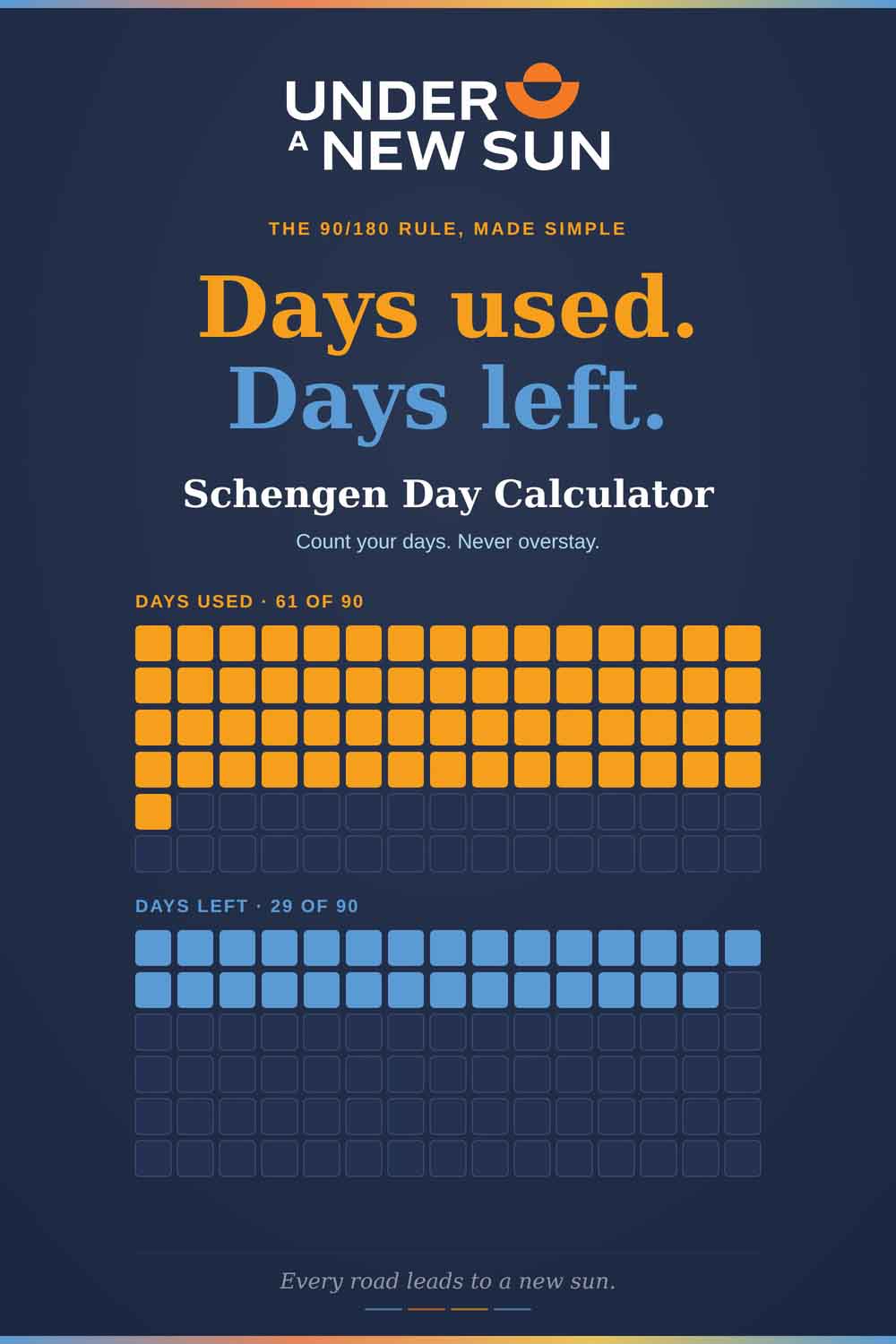
Schengen Day Calculator
Stay compliant with European immigration rules.
Calculate how many Schengen Area days you’ll use on your trip.
Calculate Your Schengen Area Days
Enter your planned arrival and departure dates. The calculator shows how many days your trip will use and whether you’re within the 90-day limit.
Include trips you have already taken in the last six months. Days from a recent trip keep counting against your 90 until they fall outside the rolling 180-day window.
Understanding the Schengen Area 90/180 Rule
What the rule actually says
Europe's Schengen Area is composed of 29 countries: Austria, Belgium, Bulgaria, Croatia, Czechia, Denmark, Estonia, Finland, France, Germany, Greece, Hungary, Iceland, Italy, Latvia, Liechtenstein, Lithuania, Luxembourg, Malta, Netherlands, Norway, Poland, Portugal, Romania, Slovakia, Slovenia, Spain, Sweden, Switzerland.
As a U.S. citizen, you can spend up to 90 days visa-free in the Schengen Area within any rolling 180-day period. That sounds simple, but the word "rolling" is where most people get confused.
If this is your first trip to Europe, or it's been more than six months since your last visit, it stays simple: as long as you're in the Schengen Area for 90 days or fewer, you're fine.
The rolling 180-day window only matters if you're making several trips across a few months, or spending a long stretch in Europe with hops in and out of the Schengen Area.
In those cases, the window doesn't start when you first arrive. It slides backward continuously from whatever date you're checking. To see how many days you've used, count back 180 days from that date and add up every Schengen day inside the window.
What counts as a Schengen day? Any day you spent in any of the 29 countries listed above.
When enough time passes and earlier trips fall outside the 180-day lookback, those days stop counting against your total. The allowance does not reset all at once. It resets day by day as old trips age out of the 180-day window.
Schengen Area: 29 countries, 1 set of rules
Every Schengen country draws from the same 90-day allowance. Time spent in any of the 29 Schengen countries counts. There's no separate limit per country.
| Example trip | Days used | Days remaining |
|---|---|---|
| Italy only, 14 days | 14 | 76 left |
| Italy 14 days + France 10 days | 24 | 66 left |
| Italy 14 + France 10 + Spain 14 + Germany 7 | 45 | 45 left |
| Multiple trips totaling 90 days | 90 | 0 left |
What if I'm staying longer, or moving there?
Planning to actually live in Europe, or stay in one country longer than 90 days? That's a different track. You'd apply for that country's long-stay visa or residence permit, and your time there is governed by that permit, not the 90/180 visa-free rule.
For those situations, the State Department points you to the embassy of the country where you'll be staying.
FAQ
If you've never traveled to the Schengen Area, your window is completely empty. You have the full 90 days available. Use the single-trip calculator above: enter your arrival and departure dates and it will tell you how many days your trip will use.
The 90-day limit only becomes complicated when you're making multiple trips within a 6-month stretch. For a single trip (your first time in Europe), just make sure your stay doesn't exceed 90 consecutive days and you're within the rules.
One question settles most of this: have you set foot in the Schengen Area in the last six months? If so, use the multi-trip calculator and enter those trips, even if you're only planning one more. Those days keep counting against your 90 until they age out of the rolling window.
To keep things simple, we'll sort travelers into three broad groups:
| Group | Who's in this group? | Which calculator? |
|---|---|---|
| 1 | 1 trip for vacation/business No Schengen days in the last 6 months, and not returning within 6 months |
Single-trip calculator |
| 2 | Multiple trips to Europe Over the next several months |
Multi-trip calculator |
| 3 | Long stays in Europe Hopping in and out of Schengen |
Multi-trip calculator |
To check your status on any given day, count back 180 days from that day and total up every Schengen day within that period. The multi-trip calculator does this math automatically.
Yes. Both your arrival day and your departure day count as Schengen days. A 14-night trip is 15 Schengen days. The calculator counts both the day you arrive and the day you leave, the same way border authorities do.
No. Stepping out of the Schengen Area doesn't reset your count. Here's how it works with a simple example:
| Dates | Where | Schengen days |
|---|---|---|
| June 1–14 | Greece | 14 |
| June 15–21 | Albania (non-Schengen) | 0 |
| June 22–30 | Greece | 9 |
| Total | 23 |
Your trip covered 30 calendar days, but only 23 are Schengen days. The week you spent in Albania does not count toward your Schengen day count, but days spent in Greece do. Your count drops only as those early-June days age out of the rolling 180-day window.
An overstay puts a violation on your record. Authorities in the country where it's detected (or at any Schengen border crossing) can ban you from the entire Schengen Area for a period of time. Repeated violations can result in longer bans and create complications for future travel.
When your 90 days are exhausted, our multi-trip calculator above shows you the earliest date you can re-enter. That's the date when enough early days have aged out of the rolling window to bring your total back below 90. You don't have to wait for the full 180 days to pass, just until the window shifts enough in your favor.
No, and we want to be direct about that. We built this planning tool to help you understand your situation before you travel. The math follows the EU's 90/180 sliding window rule, and for most travelers it will give you an accurate picture. But this calculator is not affiliated with the EU's official border system and should not be considered a legal guarantee. We've linked the European Commission's Schengen calculator in the Sources section below.
Sources
- 1U.S. State Department — U.S. Travelers in Europe / Schengen Area · Schengen 90/180 rule guidance for U.S. citizens
- 2European Commission — Official Schengen Short-Stay Calculator · The EU's own tool for calculating permitted stays
- 3European Commission — Entry/Exit System (EES) · EES rollout and Schengen border guidance