

Last updated April 28, 2026
There’s good news and there’s bad news. You’re planning a visit to the U.S. Yes! That’s the good news.
The bad news? Although U.S. sales taxes and VAT are similar in some respects, they’re also very different. Countries charging VAT allow foreign tourists to request refunds on the taxes they’ve paid on certain purchases.
Sales tax refunds are not, in general, available to foreigners visiting the U.S. There is, however, one exception to this (discussed later).
Why can’t foreign tourists request sales tax refunds in the U.S.? In short, it has to do with who charges these taxes.
Before discussing U.S. consumption taxes, though, it will be helpful to first review the various levels of government in the U.S.

Image courtesy of argus456/Pond5.
U.S.A. Government Hierarchy
Levels of government in the U.S.A.
The U.S. federal government is:
- The U.S.’s national government
- Superior to all other levels of government
- Based in Washington, D.C.
State governments
- There are 50 U.S. states, each with its own capital city and government
- The State of New York’s capital city, for example, is Albany
- States may create any laws which do not violate federal laws
- Federal laws supersede all state laws
- A state’s laws supersede all local laws in that state
County governments
- U.S. states are divided into counties
- Counties are composed of cities, towns and villages
- New York State, for example, has 62 counties
- Each county has a capital, known as the county seat
- County governments are subordinate to the state & federal governments
- County governments are superior to local governments
Local governments
- Cities, towns and villages are called municipalities
- Each municipality has its own government
- Local governments are subordinate to all levels of government above them
| Location | Type of consumption tax | Tax imposed by |
|---|---|---|
| USA | Sales tax | State & local governments |
Who charges sales tax in the U.S.A.?
U.S.A. sales taxes vs. VAT
USA consumption taxes
In the 160+ countries that charge VAT1, it is the national government who imposes this tax.
When tourists visit VAT-charging countries, they may request refunds of the VAT they’ve paid on qualifying purchases. Those refunds are processed by a country’s national government.
In the U.S., however, the federal government never charges a consumption tax. Ever.
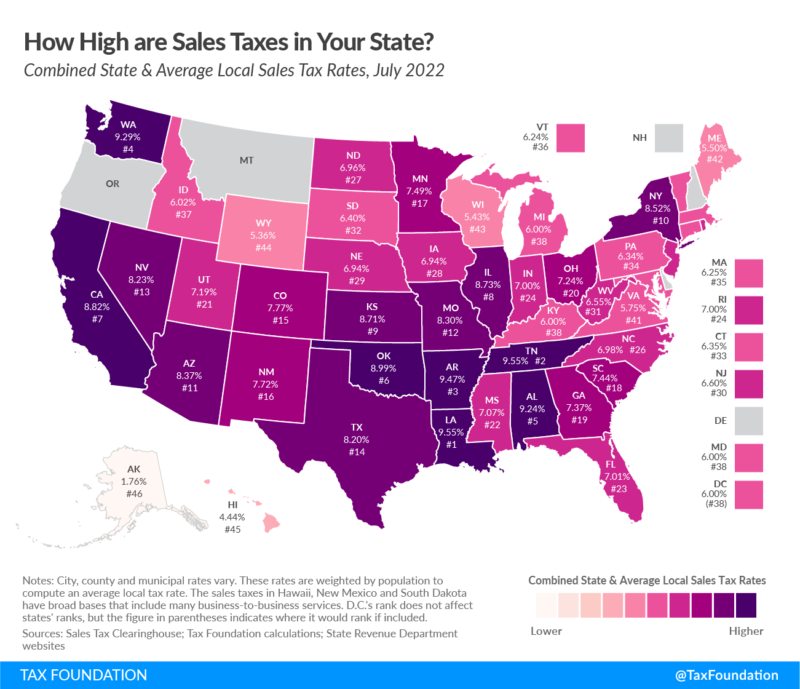
Instead, each state decides whether to charge a sales tax and how much it should be.
50 states = 50 different sales tax rates!
Not only that, county and local governments as well as other government entities may also charge their own taxes.
Here’s how the State of Illinois defines sales tax:
” ‘Sales tax’ is the combination of all state, local, mass transit, home rule occupation and use, non-home rule occupation and use, park district, county public safety and facilities, county school facility, and business district taxes. It is imposed on a retailer’s receipts from sales of tangible personal property for use or consumption.”
State of Illinois Revenue Dept.2
Thus, there is no uniform national “USA sales tax.” There are, however, a multitude of state and local taxes that, collectively, are referred to as sales tax.
In the U.S., every level of government except the federal (national) government may impose this tax.
Big City, Small City
Two examples
New York City
New York City is a city within New York State.
Shoppers in New York City pay 8.875% in sales tax.3
This 8.875% tax breaks down to:
- 4% New York State tax
- 4.5% New York City tax
- 0.375% Metropolitan Commuter Transportation District surcharge
- Total: 8.875%
What is the Metropolitan Commuter Transportation District surcharge? It’s a tax benefiting the Metropolitan Transportation Authority (MTA), the entity which runs NYC’s public transportation. It is charged within NYC and several counties near NYC.
If you leave New York City and shop elsewhere in New York State, the state tax remains 4%, but the county and local taxes will differ. In Saratoga County, New York, for example, the tax is 7% (4% state tax + 3% county tax).
McCook, Nebraska
The small city of McCook, Nebraska demonstrates how complicated sales tax in the U.S. can be.
In McCook, you’d pay a 7.5% tax:
- State of Nebraska tax: 5.5%
- Red Willow County tax: 0
- McCook tax: 2%
- Total: 7.5%4
In McCook, you’d pay the state and city taxes, but zero in county taxes.
Fun Fact — You’re probably familiar with New York City’s five boroughs. But did you know each is also a county?
Manhattan → New York County
The Bronx → Bronx County
Brooklyn → Kings County
Queens → Queens County
Staten Island → Richmond County
All five share the same sales tax rate.
How foreign tourists can save on sales tax
Options to save money
Money-Saving Option 1: Don’t pay the tax
Very simple, right? Just don’t pay it. Easy.
But you said I have to. Correct! You do have to pay it…but only if one exists.
You see, of the 50 U.S. states, four do not charge any consumption taxes whatsoever, including local taxes.
These states are:
- Delaware
- Montana
- New Hampshire
- Oregon
Alaska’s state government does not impose a sales tax, but some local governments do — and rates in certain municipalities can reach as high as 7.5%. Statewide, taxes on purchases average about 1.82%5, but always check the rate for your specific destination.
I once traveled from New York to Delaware specifically to buy computer equipment tax-free.
When I asked the saleswoman whether people come from farther away than New York to shop tax-free in Delaware, she told me about a man who flew in from California to buy a $20,000 limited-edition Apple Watch.
Using Los Angeles’s current sales tax rate of 9.5%, the man would have paid $1,900 in tax, for a total of $21,900. Even if he spent, say, $800 on his flight, hotels, and meals, he still would have saved over a thousand dollars.
It was cheaper for him to fly coast-to-coast than pay California’s taxes! With that said, U.S. sales taxes are still much lower than most countries’ VAT rates.
Money Saving Option 2: Shop in Texas
Earlier we mentioned there is one exception when it comes to sales tax refunds for foreigners: Texas.
Of the 46 states that charge tax, only Texas offers a foreign visitors refund program.
This refund program is similar to requesting VAT refunds in other countries with one big difference: U.S. federal government agents (i.e. airport customs officers) are not involved in validating your refund paperwork. Instead, refunds are handled by private companies.
Texas sales tax refunds for foreign visitors
Texas authorizes several companies to process refunds. These companies handle refunds at offices throughout the state. To qualify for refunds, purchases must be made at participating stores.

Image courtesy of Robuart/Pond5.
How to determine your destination’s tax rate
Planning tools
Use this online calculator
- Use this online sales tax calculator for the most specific results.
- You’ll need to input a specific address to use this calculator.
Range table
- Don’t need ultra-specific results? Consult a tax range table.
- This method gives you a general idea of rates, but be aware taxes can vary within a county and, sometimes, even within a city.
Look up rates on your own
For most places, just search: (city, state) + sales tax rate.
Sample searches:
- Seattle, Washington sales tax rate
- Los Angeles, California sales tax rate
Tip: Be sure your search results show the tax rate for your specific destination and not just the state. For example, if you search Houston, Texas sales tax rate, your result should specifically state Houston, Texas and not just Texas. Don’t forget, sales tax = state tax + local taxes.
How to calculate sales tax
Simplest method
Unlike in most countries, where VAT is built into the displayed price, U.S. sales tax is added on top at the register. If the tag says $100 and the local rate is 8%, you’ll be charged $108.
To calculate the total cost including sales tax, use:
Item cost x (1 + tax rate)
Reminder: Convert the tax rate to decimal form. New York City’s 8.875% rate, for example, becomes 0.08875.
Example 1:
- Item cost = $112
- Tax rate = 8.875%
- Formula: Item cost x (1 + tax rate)
- $112 x 1.08875 = $121.94 (total cost, including tax)
Example 2:
- Item cost = $112
- Tax rate = 7%
- Formula: Item cost x (1 + tax rate)
- $112 x 1.07 = $119.84 (total cost, including tax)
Notes & Citations
- 1Value-Added Tax Continues to Expand — IMF Finance & Development
- 2Sales Tax Definition — Illinois Department of Revenue
- 3NYC Sales Tax Rate — NYC Department of Finance
- 4McCook, Nebraska Tax Rate — Avalara Tax Rates
- 5Alaska Tax Profile — Tax Foundation
Affiliate disclosure: Some, but not all, links on this post are affiliate links. Any purchases made on affiliated sites result in compensation to our website at no additional cost to you.