
Last updated April 28, 2026
Union Church of Pocantico Hills
It’s uncertain whether solace and redemption await you at the Union Church of Pocantico Hills in New York’s Hudson Valley. If, however, stained glass is what ye seek, ye shall find it there.
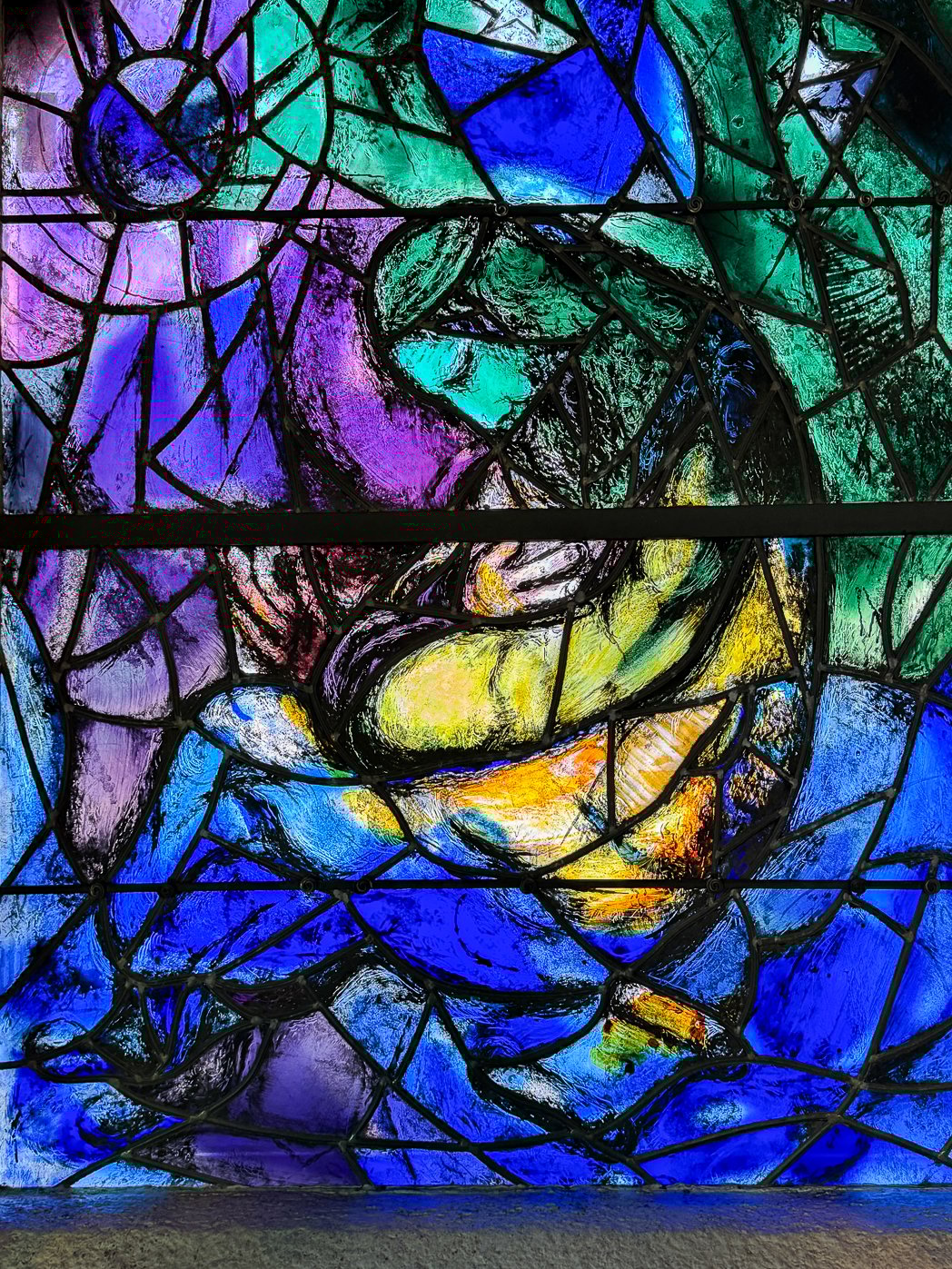
This little church, on a little hill, in a little town, on a long, winding down-home road is the domain of nine stained glass windows by Marc Chagall and one by Henri Matisse.
No neon signs announce the colorful treasures inside. Other than an occasional lawn mower and, of course, the obligatory dog barking in the distance, the church’s surrounding neighborhood is as mute as the ancient fieldstones on its facade.
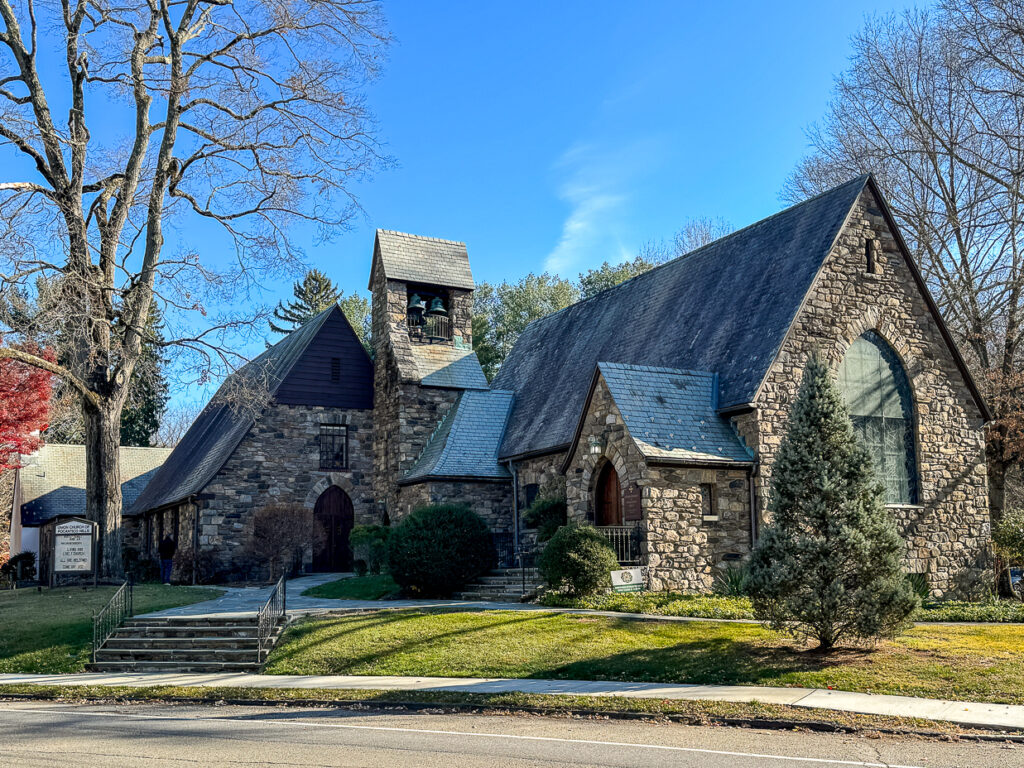
The church is just 40 miles (25 km) north of Midtown Manhattan, but light years from the art galleries, museums, urban public spaces, and opulent private collections that usually host Marc Chagall and Henri Matisse’s ouevres. Seeing their work in such a reduced, intimate setting is rare.
The Rockefeller family was directly responsible for the small church coming to be. In the 1920s, the family donated land from their expansive Hudson Valley fiefdom, known as Kykuit, and assisted in its construction.
Curiously, the stone walkway leading from the parking lot to the church is composed of fieldstones in myriad shapes, sizes, and forms resembling the various geometric pieces of glass that compose the church’s stained glass windows.
Inside you’ll find unadorned white walls and tidy rows of straight-back wooden pews facing an austere altar. Rockefeller-style religion was sober and businesslike: sit straight, listen, pray, sing, leave, collect spiritual dividends in the hereafter.
Matisse: King Chroma
In his early Paris years, Matisse was vilified as one of the ringleaders of Les Fauves (the wild beasts), a group of painters whose jaunty colors and rude brushstrokes upset the sensibilities of well-coiffed Parisian ladies and their starch-collared companions. They launched the art world equivalent of a pitchfork attack on Matisse and his chromatic cronies.
Years later, these same people declared Matisse the King of Color. The same ones who had labeled him a wild beast for his generous palette now kissed him on both cheeks, their smiles wider than the Champs Élysées. Can’t you just hear them? Why, sure, Henri and I go way back, bien sûr, baby.
Things were very different by the early 1950s. Matisse was in his 80s, sick, frail, and confined to a wheelchair. He would spend hours cutting colored paper into geometric shapes.
Matisse, the once reserved, bespectacled, studious law clerk-turned-seminal-painter now preferred his scissors to his brushes. He was done with formally working. Or so he thought.
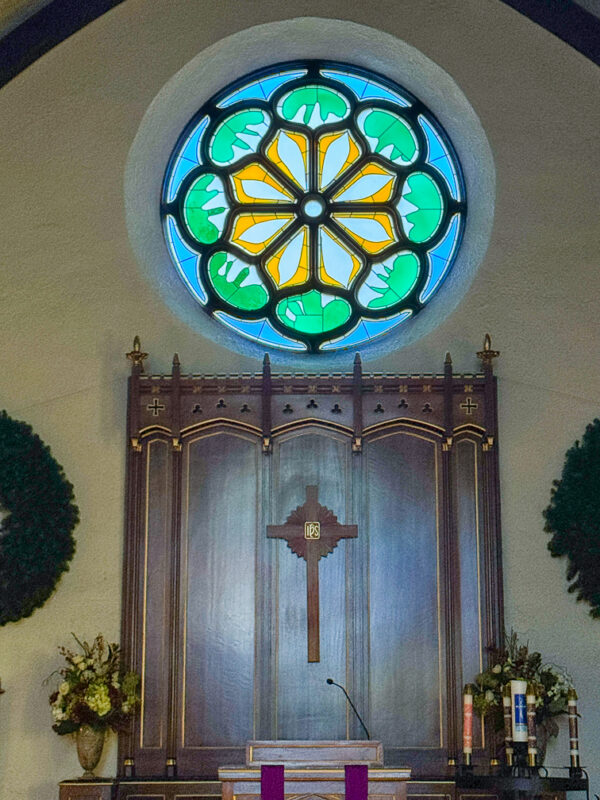
Image © underanewsun.com, All Rights Reserved
The Rockefellers had known Matisse a long time. The doyenne of New York’s Museum of Modern Art, Abby Aldrich Rockefeller, had been among the first to champion his vivid canvases in the U.S.
When she died unexpectedly in 1948, her family wanted to memorialize her with a stained glass window at the Union Church. And who better than her old friend, Matisse?
At the time, Matisse lived just a baguette’s throw away from Vence, a seaside village just minutes from the wondrous land and seascapes along France’s Côte d’Azur.
An order of nuns based there had convinced Matisse to design their new chapel. And, boy, did he design. The nuns aroused Matisse’s still firm creative muscles, prompting a four-year creative eruption by Mount Matisse.
During this four-year span, from 1947 to 1951, he designed the chapel’s architecture, altar, cult objects, pews, ceramics, holy water basins, chalice coverings, painted two stained glass windows and three murals, and chose the interior stone. Phew!
Heck, he even designed the priests’ garments. Had his trusty scissors been nearby, is it a stretch to think he may have ended up sculpting the priests’ hairstyles as well?
Too ill to attend the chapel’s opening ceremony, a priest read a message penned by Matisse.
It said, in part:
“…this work required of me four years of an exclusive and entiring effort and it is the fruit of my whole working life. In spite of all its imperfections, I consider it my masterpiece.”
Matisse Goes Up The River
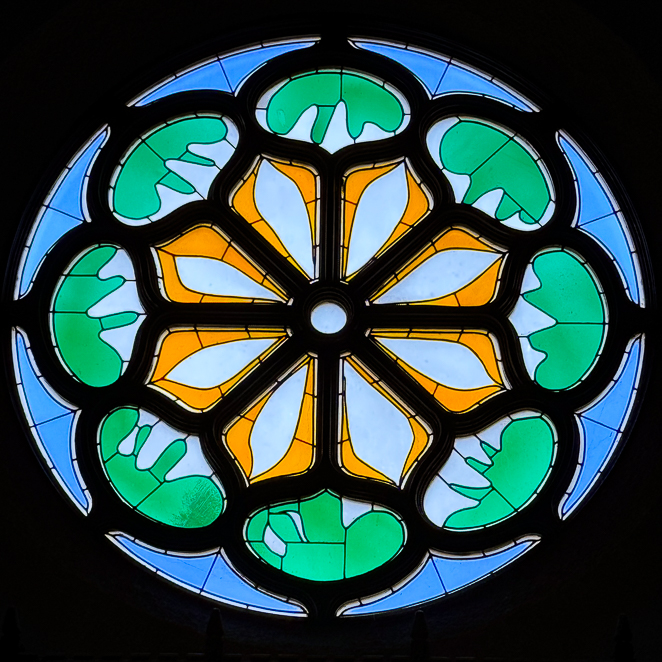
The Rockefellers eventually convinced Matisse to accept their offer of creating a commemorative Rose Window.
And there she stands today, elegant, regal, its vibrant yellow, green, and blue tones greet visitors from the back of the church as if saying, Greetings, and thank you for coming!
Is it an abstract? Does the blue mean sky? Does green symbolize nature and yellow God?
Who knows? We do know the window’s maquette (scale model) was hanging on Matisse’s wall when he passed away in 1954.
Was he staring at it as the other side whispered its icy invitation? Were silent and ancient questions posed to the unknown: Does beauty need meaning? Or reasons to exist?
Perhaps he departed smiling, lungs empty, but soul filled with wisdom revealed at the last instant: less is more.
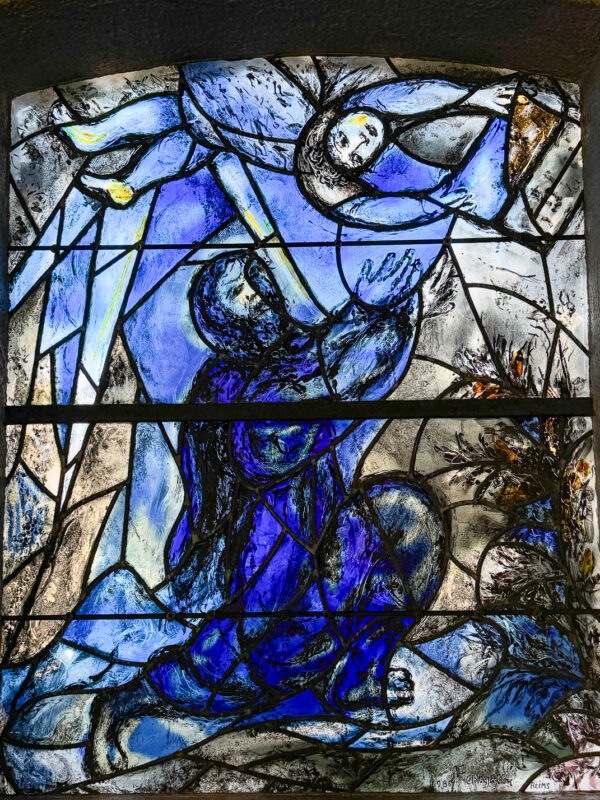
You’re Listening To Stained Glass Radio, With Your Host, Marc Chagall
“I am out to induce a psychic shock into my painting, one that is always motivated by pictorial reasoning: this is to say, a fourth dimension.” Marc Chagall
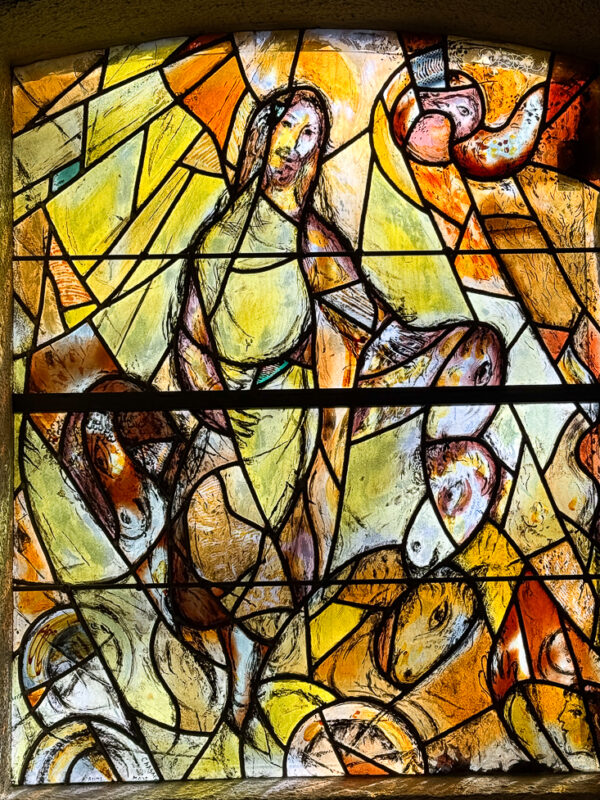
Most people consider Marc Chagall a painter, when, in fact, he was a human transistor. Upon making contact with a canvas, his brush completed a circuit which began in his soul, traveled through a mysterious, cobalt otherworld (the fourth dimension?), zigged across his mind and zagged into our reality plane.
The unusual frequency Chagall tuned-in is timeless and otherworldly: floating farmers, loving brides, flying fish, fiddle-playing goats, scenes of shtetl life long ago. These vignettes cover the mind like a midnight snowfall in January—quietly…steadily…gently.
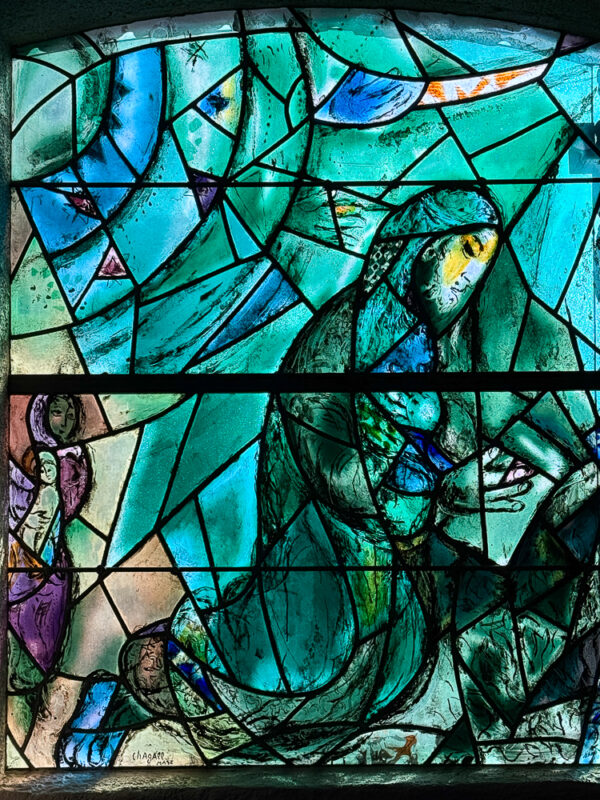
If Matisse’s Rose Window is the church’s Lady of Honor, then Chagall’s nine windows are its headline performers.
Eight smaller windows, four on each side, stand under the behemoth Good Samaritan window, which stands opposite, physically and aesthetically, to Matisse’s Rose window.
The Good Samaritan is the Generalissimo of the church’s windows. Upon entering, visitors’ necks snap upward in admiration.
Saturated reds, yellows, and greens are the counterpoints to the dense, dream-state, fourth dimension blue Chagall loved. It illustrates the biblical story of a man who helped another when others refused.
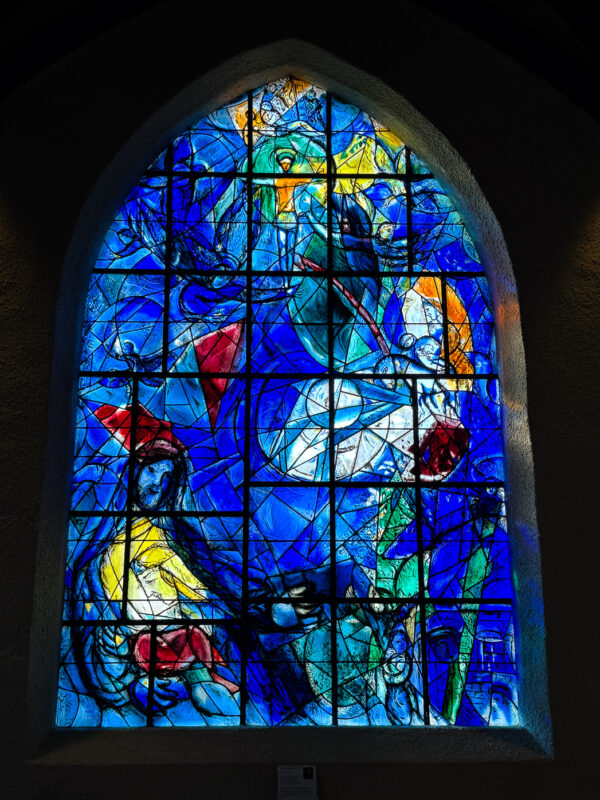
Chagall and his wife Bella had bolted from Nazi-infested Paris, landing in Vichy Marseilles. They were out of the fire, but still in the frying pan.
With the help of the Emergency Rescue Committee, a relief organization funded in part by the Rockefellers, the Chagalls were whisked through Spain and onto Portugal, where they secured passage to Gotham, arriving in New York in 1941.
Poor Chagall’s hand and back were probably sore from the many handshakes and back slaps that followed the Good Samaritan’s 1964 installation.
Perhaps in between the many bubbly-fueled compliments, he may have hinted he wasn’t averse to painting another two, three, or, say, eight more stained glass windows for the church.
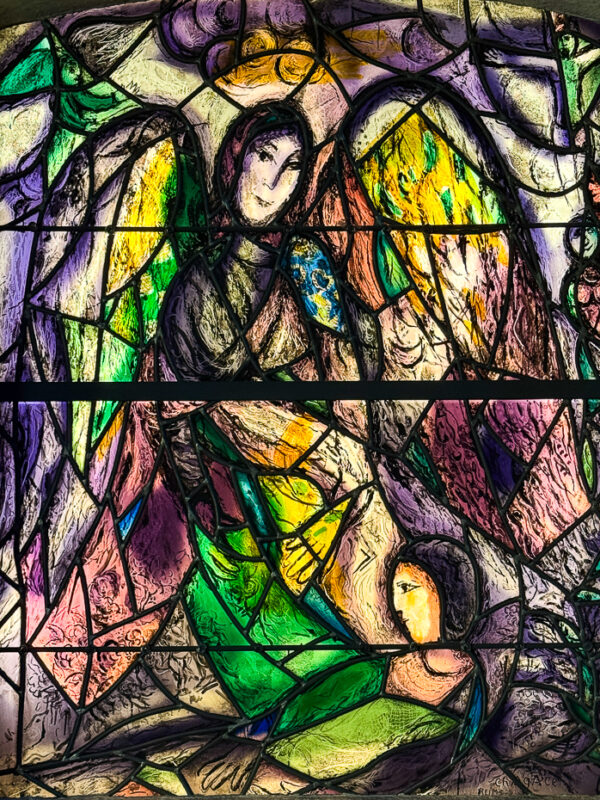
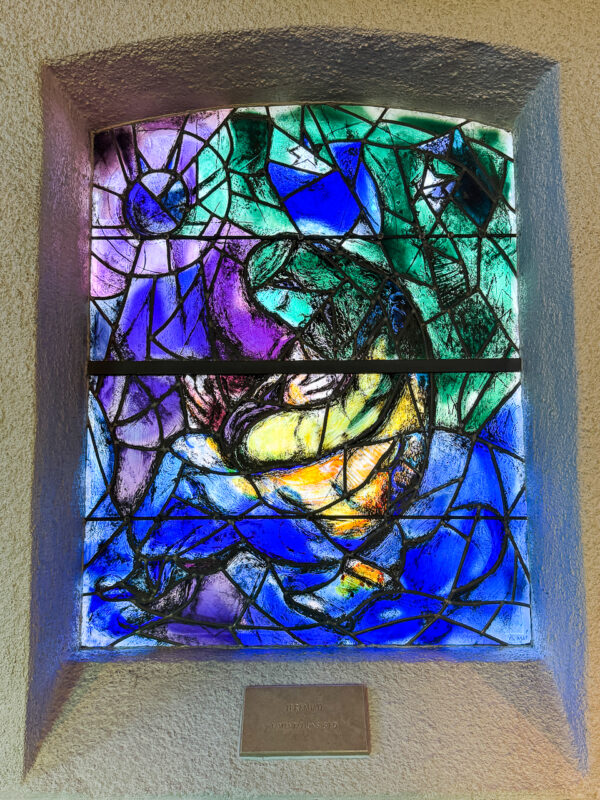
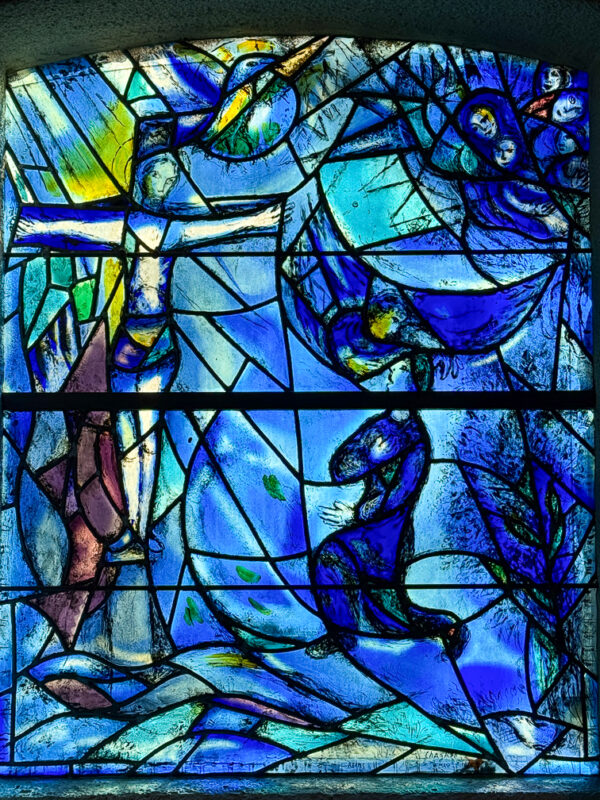
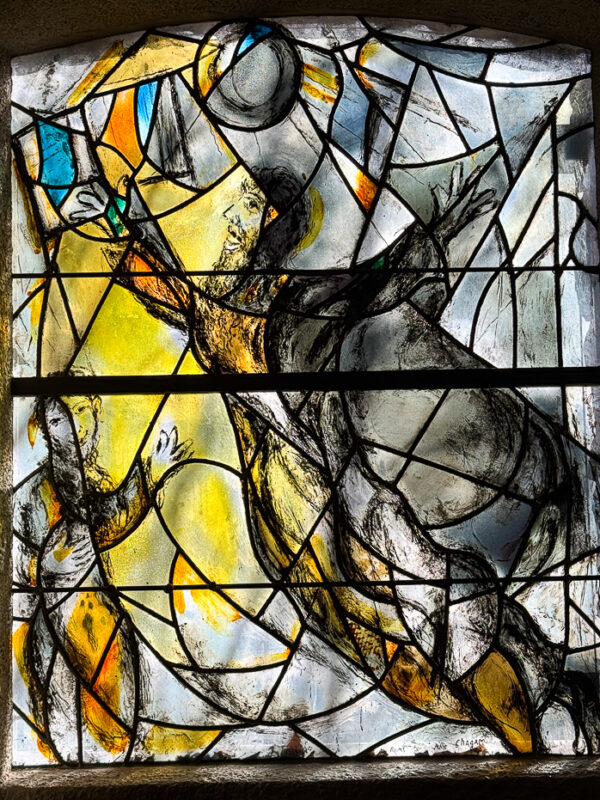
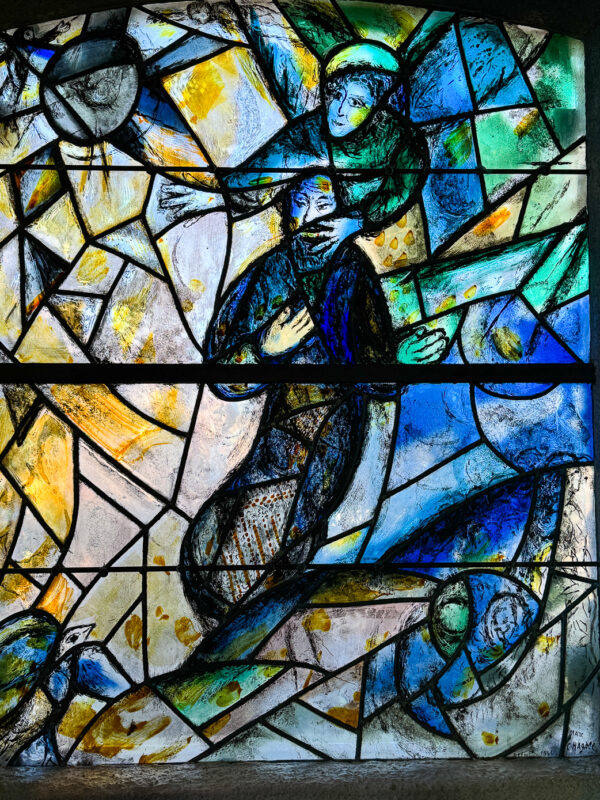
Over the next several years, Chagall did just that. After his second window, the Crucifixion, he interpreted the stories of six Old Testament All-Star prophets: Joel, Jeremiah, Ezekiel, Daniel, Isaiah, and Elijah. A Cherubim-themed window completed this stained glass Praetorian Guard.
Along the way, some congregation members grumbled their church was transfiguring into a museum. In a way, it did.
Questions
Union Church of Pocantico Hills: Frequently Asked Questions
555 Bedford Road (Route 448), Pocantico Hills, NY 10591 — about 40 miles north of Midtown Manhattan in Westchester County. Pocantico Hills shares its zip code with Tarrytown, so enter Tarrytown if your GPS doesn’t recognize Pocantico Hills.
The church is open for tours from May through December. Hours and days vary by month and are subject to change around church services, weddings, and other events. Check the current schedule at Historic Hudson Valley before visiting.
Admission is charged and managed by Historic Hudson Valley. Prices may change season to season — check current rates at hudsonvalley.org. If you’re also visiting Kykuit, the Rockefeller Estate, a combined ticket discount is available.
By train (recommended): Take Metro-North’s Hudson Line from Grand Central Terminal to Tarrytown. Buy your ticket before boarding to avoid the on-board surcharge, and take an express train when available. From Tarrytown station, the church is about 10 minutes by taxi or rideshare. View the Metro-North map — the Hudson Line is the green line, left of center.
Address: 555 Bedford Road (Route 448), Pocantico Hills, NY 10591.
By car: The church is roughly 40 miles from Midtown Manhattan — typically 45 to 60 minutes depending on traffic. If your GPS doesn’t recognize Pocantico Hills, enter Tarrytown as the city. There is a small parking lot next to the church.
Most visitors spend 30 to 45 minutes inside. That’s enough time to take in all ten windows at a comfortable pace with staff on hand to provide context. If you’re combining the visit with a walk around the grounds or a stop at nearby Kykuit, the Rockefeller Estate, plan for at least a half-day.
Yes — personal photography inside the church is permitted. Tripods are not allowed. This is an active house of worship, so be respectful of the space and any services in progress.
Visits are informal — knowledgeable staff are on hand and happy to walk you through the windows and share the stories behind them. There’s no formal tour schedule to follow, so you move at your own pace.
The Rockefeller family commissioned all ten windows as private memorials. Matisse’s Rose Window was created in memory of Abby Aldrich Rockefeller, the family matriarch and one of the founders of MoMA. Chagall’s windows were commissioned over several decades, each honoring a different member of the family.
Yes. The maquette — the scale model Matisse worked from — was still hanging on his studio wall when he died in November 1954. He never saw the finished window installed in the church. It is widely considered his final creative work.
It was a debt of survival. When Chagall and his wife Bella fled Nazi-occupied Paris in 1941, the Emergency Rescue Committee — funded in part by the Rockefellers — helped arrange their escape through Spain and Portugal to New York. When the Good Samaritan window was installed in 1964, Chagall didn’t just accept the commission — he kept coming back, eventually painting nine windows in total.
The Daniel window is positioned closest to Matisse’s Rose Window. Chagall deliberately chose a subdued palette so his window wouldn’t compete with Matisse’s for attention — a quiet act of artistic deference to his old friend. Daniel’s outstretched hand is even thought to point toward the Rose Window, as if acknowledging it.
Original photography in this article is © underanewsun.com, All Rights Reserved. Unauthorized reproduction is prohibited.
Gorgeous! Thanks for sharing!
Thank you! Glad you enjoyed it and hope you’ll be able to visit the church.